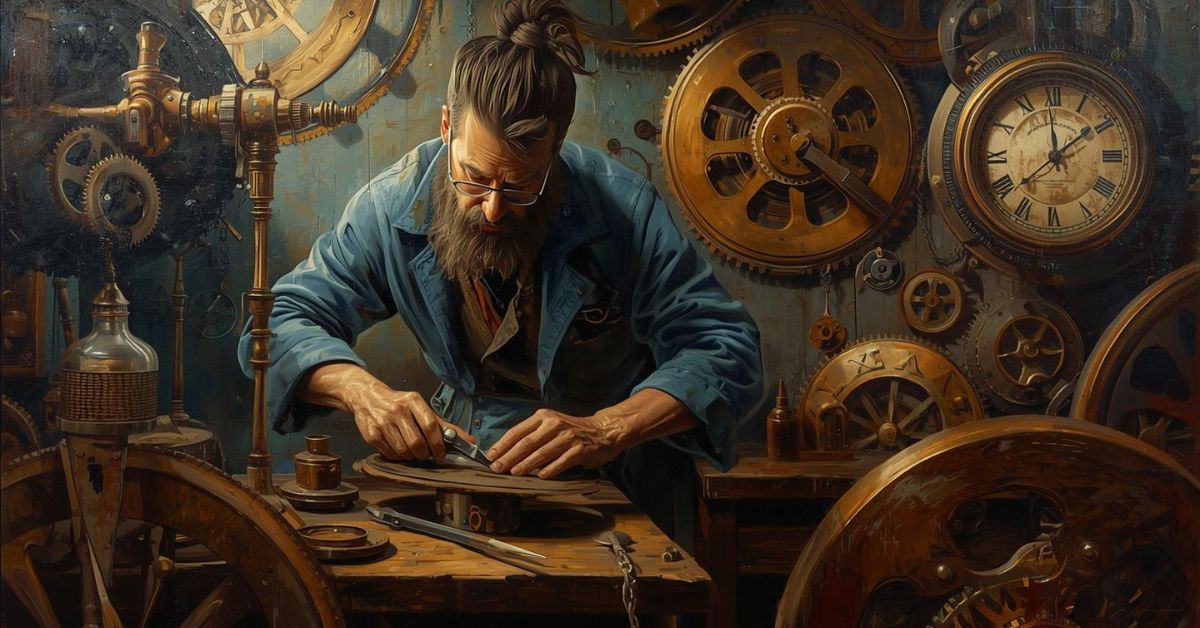
In a narrow street where the sun never quite reached the ground, there stood a shop filled with clocks that refused to agree with each other.
Some ran fast. Some lagged behind. One ticked backward with stubborn insistence.
Above the door, a brass sign read: TOMORROWS REPAIRED.
No one in the city spoke much about the clockmaker. Not because they didn’t know him—but because they did.
“If you go in,” people said, “you won’t come out the same day.”
Arin went anyway.
He had spent weeks replaying a single moment: the argument, the slammed door, the silence that followed. There were words he hadn’t said—words that now had nowhere to go.
Inside, the shop was quieter than expected. Not silent, but careful. As if every tick had been placed deliberately.
The clockmaker stood behind a workbench, adjusting a pocket watch with delicate precision. He didn’t look up.
“You’re late,” he said.
“For what?” Arin asked.
“For tomorrow.”
Arin frowned. “I don’t understand.”
“No one ever does,” the clockmaker replied, finally meeting his eyes. “That’s why they come here.”
Arin swallowed. “I want to fix something.”
“Of course you do.”
The clockmaker set the watch down and gestured to the walls. Hundreds of clocks. Thousands, maybe. Each one labeled with a date.
Not past dates.
Future ones.
“You don’t repair tomorrows,” Arin said slowly. “You… take them.”
The clockmaker smiled faintly. “Borrow. Steal. Reassign. Words depend on perspective.”
Arin stepped closer. “Can you give me one?”
“I can give you many,” the clockmaker said. “That’s not the difficult part.”
“What is?”
“Choosing which tomorrow you’re willing to lose in return.”
Arin’s chest tightened. “Lose?”
The clockmaker nodded toward a small drawer. “Everyone has a limited number. You just don’t notice them disappearing.”
Arin hesitated. “How does it work?”
The clockmaker pulled out a thin, silver device shaped like a key. “You tell me the moment you want to return to. I unlock it. You step in. You change what you think you need to change.”
“And then?”
“Then the cost is taken,” the clockmaker said simply.
Arin thought of the argument again. The look on her face. The way he had chosen pride over honesty.
“What’s the cost for one day?” he asked.
The clockmaker tilted his head. “Not a day. A tomorrow.”
“That’s the same thing.”
“No,” the clockmaker said gently. “A day is time. A tomorrow is possibility.”
Arin didn’t fully understand—but he felt the weight of it.
Still, he nodded. “I’ll pay it.”
The clockmaker handed him the silver key.
“Choose carefully,” he said.
The moment returned like a door opening.
Arin stood in the familiar room. The argument unfolding exactly as before. The same words, the same tension—but this time, he knew where it led.
So he changed it.
He listened instead of interrupting. He spoke instead of withdrawing. He stayed when he would have left.
And when the moment ended, it didn’t end in silence.
It ended in understanding.
Arin woke the next morning in his own bed.
For a second, everything felt right.
Then he noticed something strange.
The calendar on the wall skipped a date.
Tuesday… Thursday.
Wednesday was gone.
He frowned, uneasy.
As the days passed, more things began to shift.
Plans he remembered making no longer existed. Opportunities he had been waiting for never came. Conversations ended before they began.
Each missing tomorrow wasn’t just time—it was something that could have happened, but never would.
Arin returned to the shop.
“You didn’t tell me it would be like this,” he said.
“I did,” the clockmaker replied calmly. “You just didn’t understand.”
Arin clenched his fists. “Take it back.”
The clockmaker shook his head. “Time doesn’t do refunds.”
“Then give me another chance,” Arin said desperately.
The clockmaker studied him. “Another tomorrow?”
Arin hesitated.
He thought about what he had gained.
He thought about what he had lost.
And for the first time, he understood the difference.
Slowly, he stepped back.
“No,” he said quietly.
The clockmaker nodded once, as if that had been the answer all along.
“Most people keep buying,” he said. “Until they run out.”
Arin glanced at the clocks lining the walls—each one ticking toward something unseen.
“How many do I have left?” he asked.
The clockmaker smiled faintly.
“Enough,” he said. “If you stop spending them trying to fix yesterday.”
When Arin stepped outside, the street felt different.
Not changed.
Just… fragile.
For the first time, he didn’t rush forward.
He simply stood there—aware that tomorrow was not guaranteed, not stored, not replaceable.
Only lived.
And somewhere behind him, in a shop full of ticking possibilities, another clock quietly stopped.
Tags: time, clockmaker, destiny, choices, steampunk, fate, consequences